

How Are Stabilizer Links Influencing Vehicle Handling Expectations Worldwide?
2025-12-17
Stabilizer links—also referred to as sway bar links or anti-roll bar links—are critical suspension components designed to connect the stabilizer bar to the vehicle’s control arms or struts. Their primary role is to transfer load during cornering, acceleration, and braking, thereby reducing body roll and maintaining tire contact with the road surface. As global vehicle platforms evolve toward higher performance, heavier curb weights, and more complex suspension geometries, stabilizer links have become a focal point for engineers seeking consistent handling and predictable ride characteristics.
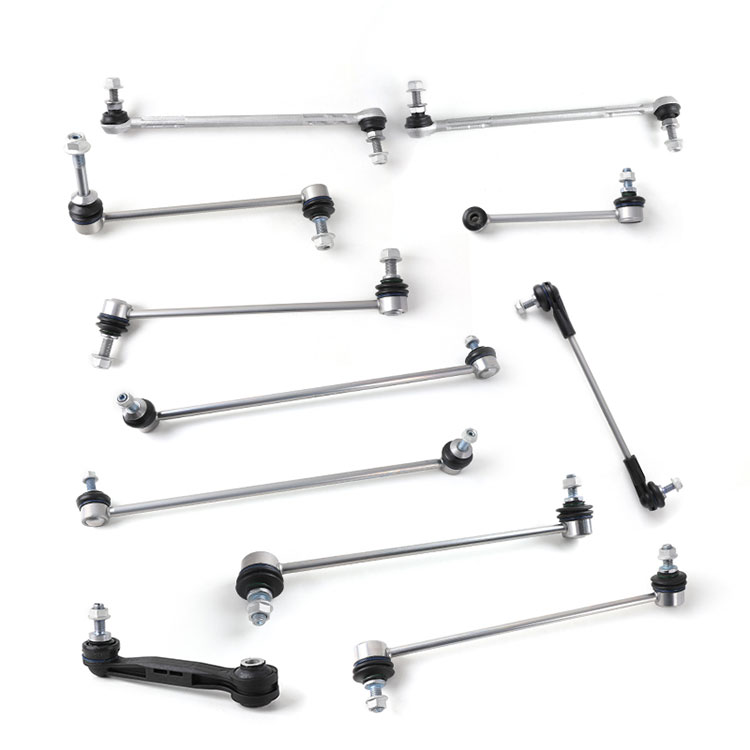
The central thesis is straightforward: stabilizer links are no longer passive connectors. They are precision-engineered components whose specifications and manufacturing quality directly influence steering response, ride stability, and long-term suspension durability.
How Do Stabilizer Links Work Within a Suspension System?
Stabilizer links operate as mechanical intermediaries between the stabilizer bar and the suspension assembly. When a vehicle enters a turn, lateral forces cause the body to lean. The stabilizer bar resists this lean by twisting, and the stabilizer links transmit that torsional force to the suspension on both sides of the axle.
Mechanical Interaction Explained
During straight-line driving, stabilizer links experience minimal load. However, when one wheel compresses more than the other—such as during cornering or uneven road conditions—the stabilizer bar twists. The stabilizer link on the compressed side transfers force upward or downward, depending on suspension design, while the opposite link counterbalances the movement. This interaction limits excessive roll and improves directional stability.
Structural Design Considerations
A typical stabilizer link consists of:
-
A central rod or shaft
-
Ball joints or bushings at each end
-
Protective dust boots
-
Threaded ends or integrated mounting studs
The integrity of each element determines how efficiently force is transmitted. Ball-joint-style links allow multi-axis articulation, making them suitable for MacPherson strut suspensions. Bushing-style links, often made with elastomer compounds, are commonly used in applications where noise isolation is prioritized.
Key Product Parameters
The following table outlines standard parameters commonly evaluated when selecting stabilizer links for OEM or aftermarket use:
| Parameter | Typical Specification Range |
|---|---|
| Overall Length | 80 mm – 350 mm |
| Rod Material | Carbon Steel / Alloy Steel |
| Surface Treatment | Phosphate Coating / E-Coating |
| Joint Type | Ball Joint or Rubber Bushing |
| Thread Size | M8 – M14 |
| Operating Temperature | -40°C to +120°C |
| Dust Boot Material | Neoprene or Silicone Rubber |
These parameters must align precisely with vehicle suspension geometry. Even minor deviations in length or joint articulation angle can introduce preload, leading to premature wear or compromised handling performance.
How Should Stabilizer Links Be Selected for Different Driving Conditions?
Selecting the correct stabilizer link involves more than matching vehicle make and model. Driving conditions, load profiles, and suspension tuning objectives all influence the optimal specification.
Passenger Vehicles and Daily Commuting
For standard passenger cars, stabilizer links are typically designed to balance ride comfort and handling control. Rubber-bushed links are often preferred due to their ability to absorb vibration and road noise. Corrosion-resistant coatings are essential in regions with high humidity or winter road salt exposure.
SUVs and Light Trucks
Heavier vehicles place greater stress on suspension components. Stabilizer links in these applications require higher tensile strength and reinforced ball joints to withstand increased lateral loads. Extended service life is often achieved through thicker rod diameters and enhanced sealing systems to prevent contaminant ingress.
Performance and Sport-Oriented Applications
In performance-focused setups, stabilizer links must provide immediate force transfer with minimal compliance. Ball-joint designs with hardened steel housings are commonly used to ensure precise steering feedback. Dimensional accuracy is especially critical, as performance suspensions often operate with reduced tolerances.
Installation and Alignment Considerations
Proper installation torque and suspension neutral positioning are essential to avoid bushing preload. Preloaded stabilizer links can alter ride height symmetry and introduce uneven handling characteristics. Professional installation guidelines typically recommend tightening links with the vehicle at normal ride height.
Market Outlook, Common Questions, and Brand Integration
How Is the Global Demand for Stabilizer Links Evolving?
Vehicle platforms are becoming more standardized globally, yet suspension tuning remains region-specific. This dynamic has increased demand for stabilizer links that meet strict dimensional and durability requirements while accommodating diverse road conditions. Growth in electric vehicles and hybrid platforms has also influenced stabilizer link design, as battery weight distribution introduces new load patterns within the suspension system.
Manufacturers are responding with improved material science, tighter production tolerances, and expanded compatibility ranges. Quality assurance processes such as fatigue testing and salt spray resistance testing have become baseline expectations rather than differentiators.
Stabilizer Links FAQ
Q: How often should stabilizer links be replaced under normal driving conditions?
A: Under typical driving conditions, stabilizer links are designed to last between 60,000 and 100,000 kilometers. Replacement intervals may be shorter in regions with poor road conditions, aggressive driving habits, or frequent exposure to moisture and road debris.
Q: What are the common signs of stabilizer link wear or failure?
A: Common indicators include clunking noises during cornering or over bumps, reduced steering stability, uneven tire wear, and increased body roll. Visual inspection may reveal torn dust boots or excessive joint play.
Brand Perspective and Contact Invitation
As suspension systems continue to advance, the importance of reliable stabilizer link manufacturing cannot be overstated. Shine Way focuses on delivering stabilizer links engineered to meet stringent dimensional accuracy, material strength, and durability requirements across a wide range of vehicle applications. Through consistent quality control and application-specific design, Shine Way products align with the expectations of distributors, workshops, and fleet operators seeking dependable suspension solutions.
For further product details, technical specifications, or cooperation inquiries, interested parties are encouraged to contact Shine Way directly. A dedicated support team is available to provide application guidance and respond to sourcing requirements efficiently.